
Insight arts
0-1 startup project | new york
jun 28-dec 16, 2025
"A non-profit organization and artist collection that supports and celebrates visually impaired artists. Our mission is to elevate artists of all abilities through art, advocacy, and community."
-
My Role: UX Design Intern
-
Team:
-
Founder
-
Head of Branding
-
Head of UX
-
Lead UI/UX Designer
-
-
Tools: Figma

The Problem
How might we reduce barriers for visually impaired artists to share their work and engage with creative opportunities in a way that is both accessible and meaningful?
Designing for visually impaired users required adherence to accessibility standards to ensure the platform was usable, navigable, and inclusive.
ada compliancy takeaways
.png)
color contrast
Must ensure color contrast for users with low vision
Screen readers must be able to interpret pages effectively
.png)
screen reader compatibility
Secondary Research
Readable typography is essential for accessibility
Complex navigation can be difficult for visually impaired users

text & typography
.png)
navigation simplicity
user flows
With a focus on the shop page, I designed a streamlined user flow that prioritizes clarity, accessibility, and ease of navigation. The goal was to ensure that users of all abilities could browse, understand, and purchase artwork without confusion or unnecessary friction.

Design system
Following both the branding for the company and the requirements for ADA Compliancy, we utilized a design system that had good visual contrast while preserving the beauty of the website




Product
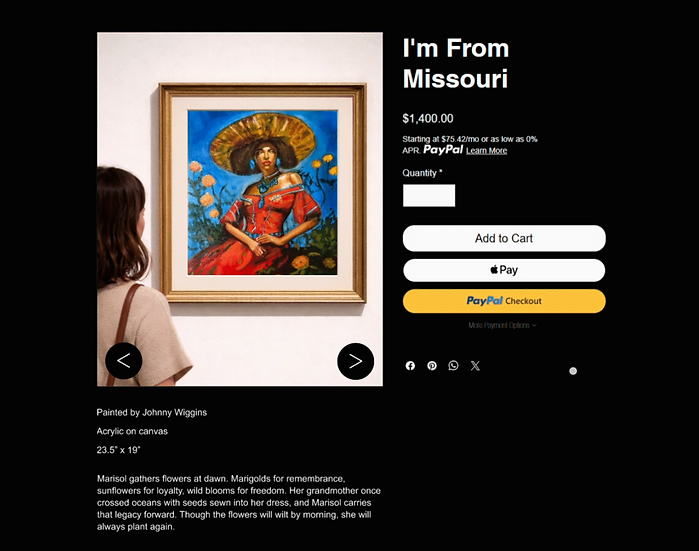
We developed a platform that balances creativity with accessibility, allowing visually impaired artists to showcase and sell their work. Working under the guidance of my UX Lead, Lauren Tsao, I contributed to the design and development of this site, with my primary focus being the shop page.
Working within Wix while adhering to the design system introduced technical constraints that required thoughtful adjustments to maintain consistency and accessibility.
Key takeaways
.png)
Accessibility shapes experience
Designing for ADA compliance required every element, including the layout, navigation, and hierarchy, to be intentional and usable for visually impaired users
This showed me how designing for a specific audience shapes the entire experience
Simplicity reduces barriers
Balancing a large amount of information while maintaining clarity reinforced that simplicity isn’t a limitation, it’s necessity
Reducing complexity made the experience more accessible and easier to navigate
Decisions must be intentional
Every decision was grounded in research and made with purpose
This project emphasized that within an effective design, each component is carefully considered to support the user.